|
Picture of the day -
March 1, 2006
Railroad Tracks Near Emory, VA
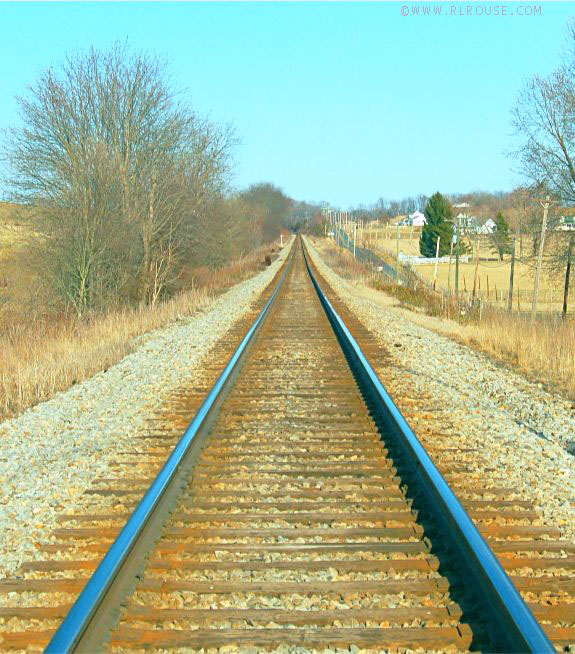
Today's picture features the Norfolk & Southern railroad tracks near
Emory, Va. Norfolk & Southern is one of the nation's largest and most powerful
railroads with operations in 22 eastern states, Washington, DC and Ontario,
Canada.
Long before interstate highways crisscrossed the nation - in fact long before
there were automobiles to drive on them, the primary mode of long-distance
transportation was the train. It's doubtful that the America we know and love
today would even exist in its present form were it not for the railroads.
In the early 1800's, California and what would eventually become the western
United States was more or less isolated from the by-then well established
population centers and industrial infrastructure back east. An overland trip
"out west" took several months of very difficult travel, and moving heavy
machinery across the country was simply impossible - it had to be taken by ship
all the way around Cape Horn!
Recognizing the need to build a railroad that crossed the entire North American
continent, orators of the day joined the newspapers in lobbying the politicians
for money and personnel to build this transcontinental railroad. In 1853,
Congress approved a then-whopping $150,000 to seek out a feasible route for the
railroad bed. After several fits and starts, the surveying and construction
began in earnest.
As crews moved across the country trying to decide where the railroad should go,
numerous small towns and villages lobbied them with explanations of why the
tracks should run through their towns. The "winning" localities prospered
because of the money, supplies and settlers that came into town on the trains -
inevitably some of each would stay behind when the trains pulled out to continue
their cross-country journey.
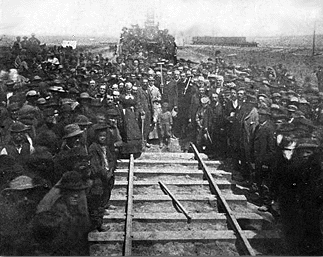 On May 10, 1869, the "Golden Spike" was driven at Promontory, Utah, the place
where the tracks laid by the Central Pacific Railroad had finally joined those
of the Union Pacific - the Transcontinental Railroad was now complete. On May 10, 1869, the "Golden Spike" was driven at Promontory, Utah, the place
where the tracks laid by the Central Pacific Railroad had finally joined those
of the Union Pacific - the Transcontinental Railroad was now complete.
The completion of the Transcontinental Railroad was the single most important
event leading to the cultural and economic development of the west. A trip that
once took months now took just a few days, and not just for settlers and
workers. It also included the heavy machinery that was so desperately needed to
build modern cities and industries on the west coast.
Eventually, several other transcontinental railroads were built and tracks were
laid connecting most parts of the U.S. like a huge spider web. Within just a few
short years the culture and economic power of the west coast has pretty much
caught up with the east.
In recent times we haven't given much thought to the railroads - indeed, many
smaller rail lines now sit idle. But thousands of miles of those cold steel
rails still deliver much of the nation's goods to points far and wide, and with
the price of crude oil recently reaching record levels the railroads are quickly
regaining the respect they enjoyed back "when the west was young".
Picture Of The Day Homepage |
Submit
a photo
More Interesting Articles
|
|
|