|
The amazing Hubble Space Telescope is a modern-day marvel of
science and engineering. Named for a true giant in the field of Astronomy, Edwin
Hubble (1889-1953), the Hubble Telescope has brought parts of the universe into
view that are literally impossible to see clearly from the earth's surface.
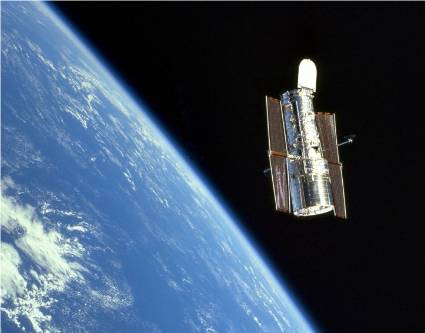
The Hubble Space Telescope (photo courtesy of NASA)
Why do we need a space telescope?
Ever since 1609 when Galileo used first used a telescope to view the night sky,
humans have been building ever larger and better telescopes which allowed us to
see farther and farther out into space. Objects that were once invisible came
into view, and with each advance in technology we were able to discover and
examine objects
located at greater distances from the earth.
But there was a serious problem that hindered astronomers in their efforts to
see vast distances: the earth's atmosphere. The atmospheric gases distort light
as it passes through them. This phenomenon is what gives stars their
"twinkle". It also blurs the images of distant objects viewed
through a telescope.
Ever since the 1940's, astronomers have dreamed of placing a telescope in space
where they would be unaffected by the atmosphere. In the 1970s, NASA and the European
Space Agency started a joint venture to build a space telescope and place it
into orbit around the earth.
It was decided that the remarkable device would be named after Hubble in
recognition for his numerous contributions to the science of astronomy. The
astronauts aboard the space shuttle Discovery successfully placed the Hubble
Space Telescope into orbit some 380 miles above the earth's surface
on April 25, 1990.
Houston, we have a problem!
The successful launch of the Hubble Telescope was met with enthusiastic cheers
from the entire astronomical community, but elation soon turned into a slight
case of disappointment when it was discovered that the Hubble's mirror had a
flaw that prevented the device from focusing correctly.
Why was the disappointment only slight? Because even with the flaw the telescope
sent breathtaking images of the most distant objects ever viewed by humans back
to earth. The Hubble was a huge success even with the flaw!
Hubble's problem fixed
In March of 2002, the astronauts aboard the space shuttle Columbia paid a visit
to the Hubble and replaced the flawed parts with new ones. The improvement was
immediate and magnificent - suddenly astronomers (and the world at large) were
peering at images of galaxies hundreds of light years away, in sparkling clarity!
At last, the full dream of what a space telescope would allow humans to see had
been realized.
More Interesting Articles
|